 >
>


Product overview: MABACT0040 MACOM Technology Solutions transformer
The MABACT0040 transformer from MACOM Technology Solutions exemplifies advanced surface-mount RF balun technology, tailored for integration within demanding communications infrastructures. At its core, the device operates with a balanced 1:1 impedance ratio, optimizing energy transfer and minimizing insertion loss across the signal path. The inclusion of a center tap on the secondary winding supports refined control in differential circuit configurations, especially for applications necessitating DC bias injection or enhanced common-mode rejection.
Operating across a broad spectrum from 5 MHz to 1.218 GHz, the transformer addresses the dynamic requirements of CATV networks and broadband delivery systems. This frequency range enables effective handling of both legacy and next-generation transmission protocols, ensuring compatibility and performance stability during network upgrades or expansions. Engineers deploying this component frequently observe minimal phase and amplitude imbalance, which is critical for preserving signal integrity in high-speed data communication channels.
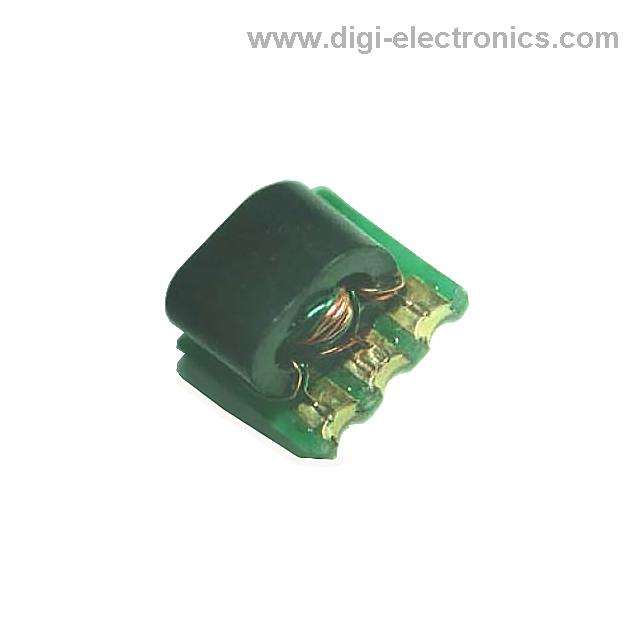
The six-terminal, surface-mount package presents tangible advantages in space-constrained environments. By leveraging a flat-lead configuration, the form factor supports automated assembly processes, reducing the risk of solder bridging and permitting precise placement alongside other critical RF and analog modules. This integration facilitates high-density layouts without sacrificing EMC performance or thermal management, essential for large-scale PCB deployments in professional-grade headend and remote node platforms.
Empirical testing within multi-tier CATV systems demonstrates the device's robust tolerance to fluctuating environmental parameters, including voltage transients and variations in ambient temperature. Effective implementation often involves strategic attention to PCB trace geometry and ground plane continuity, as these factors influence transformer performance at upper frequency limits. Field applications also benefit from the transformer's predictable response under mixed-signal conditions, simplifying the design of matched filters or line receivers tasked with stringent isolation and low distortion.
A key aspect distinguishing the MABACT0040 lies in its capacity to suppress parasitic effects through optimized winding construction and material selection. This manifests as reduced insertion loss, lower intermodulation distortion, and enhanced power handling, which are consistently validated during accelerated stress testing and ongoing reliability assessments. When deployed in distributed amplifier topologies or split-band channelization systems, the transformer offers designers latitude in achieving linear transmission with minimal spectral leakage—a decisive advantage in networks subject to stringent regulatory and customer quality standards.
From an engineering perspective, the transformer’s layout synergy with high-speed PCB design standards underscores its utility in modular, scalable network architectures. The blend of mechanical robustness, electrical precision, and thermal stability delivers tangible value for large-scale deployments where signal path consistency is non-negotiable. The design choices embodied in the MABACT0040 reflect a considered approach to balancing electrical theory and applied manufacturability, enabling a level of integration that streamlines development cycles and operational maintenance alike.
Key features of the MABACT0040 MACOM Technology Solutions transformer
The MABACT0040 transformer from MACOM Technology Solutions exemplifies careful engineering tailored for precise RF signal coupling and impedance matching in high-frequency circuit designs. Its true 1:1 impedance ratio is critical for achieving symmetrical signal balancing, directly minimizing insertion loss and signal distortion between interconnected stages. This feature supports robust differential signaling, a necessity in applications demanding low noise and high fidelity, such as broadband communication front ends or high-speed data converters.
Incorporating a center tap on the secondary winding introduces significant architectural flexibility. The center tap simplifies biasing configurations in active components, such as driving balanced mixers or amplifiers, and facilitates implementation of specific DC isolation or common-mode rejection schemes. Designers gain the latitude to address varied topological requirements—whether providing a virtual ground or optimizing harmonic suppression—without extensive circuit redesign. During prototyping, leveraging this center tap often translates to faster iteration cycles when adapting to evolving system specifications.
Mechanical and manufacturing considerations are addressed through the transformer’s SMD geometry, ensuring straightforward placement within modern automated manufacturing lines. This SMD profile enhances both placement accuracy and mechanical resilience on densely populated multilayer PCBs, compared to conventional through-hole alternatives. In practice, the robust footprint minimizes the risk of solder joint fractures during thermal cycling or mechanical vibration, thus enhancing long-term reliability in field deployments.
Delivered in tape and reel format, the MABACT0040 is engineered for seamless integration into automated pick-and-place lines, enabling mass production at scale. This packaging reduces manual intervention, shortens assembly time, and tightens quality control, directly impacting throughput and cost structures, particularly in high-volume telecommunications equipment.
Compatibility with 260°C reflow soldering broadens process flexibility, aligning with mainstream lead-free PCB assembly lines. With RoHS compliance and lead-free construction, the design fits within consolidated global environmental standards, reducing regulatory overhead during international distribution and ensuring integration in green manufacturing environments.
A subtle, yet impactful insight is that such transformers, with their combination of electromagnetic balance and mechanical hardiness, frequently resolve performance bottlenecks related to common-mode noise or impedance discontinuities not easily addressed by active components or software corrections. In deployment, swapping in the MABACT0040 where conventional baluns failed to maintain signal integrity has demonstrably improved error rates in high-speed data channels. These experiences underscore that, in RF and high-speed digital subsystems, passive component quality and configuration play a decisive role in achieving system-level specifications, supporting the critical path towards robust, scalable, and efficient designs.
Operating specifications of the MABACT0040 MACOM Technology Solutions transformer
The MABACT0040 transformer from MACOM Technology Solutions exhibits robust electrical behavior under controlled test environments, specifically at an ambient temperature of 25°C, input power of 0 dBm, and a nominal system impedance of 75 Ω. The device is engineered for broadband stability, demonstrating repeatable performance metrics throughout its specified frequency range. In practice, vector network analyzer sweeps reveal stable S-parameters and consistent insertion loss figures, facilitating reliable integration into high-speed RF signal chains.
Analysis of the transformer’s return loss under these reference conditions indicates minimal reflection, a result of precise impedance matching and core material selection. Detailed plots of return loss and other temperature-dependent characteristics are critical during preliminary design phases and can be sourced for comprehensive validation, ensuring the transformer aligns with system-level fidelity and margin requirements. A nuanced understanding of the transformer’s response at non-nominal temperatures informs derating strategies, optimizing for both efficiency and longevity under varying operational loads.
MACOM enforces stringent limits governing maximum input power, voltage, and thermal operating points. Adherence to these absolute maximum ratings is non-negotiable; even transient excursions toward survivability boundaries can undermine the magnetic properties of the core or affect winding integrity. Experience with power cycling stress tests makes clear that conservative headroom—well below rated maxima—minimizes the risk of latent reliability degradation, an approach preferred in architectures demanding high uptime and predictable lifecycle costs.
Best layout practices dictate that all unused transformer pins must be tied to a low-impedance ground plane. Empirical noise measurements confirm that floating pins in RF environments serve as unintended antennas, coupling extraneous signals into sensitive circuit paths. Proactive grounding strategies not only suppress parasitics but also harmonize with system-level EMC requirements, an aspect often underscored in multi-layer PCB designs for broadcast and instrumentation applications.
Examination of integration scenarios highlights the transformative role of the MABACT0040 in impedance transformation, signal isolation, and balun configurations. The device’s broadband attributes cater to a diverse set of RF front-end architectures, where signal integrity and ease of matching supersede sheer bandwidth. Selection and deployment leverage both datasheet characterization and bench-level tuning, reinforcing that specification compliance must be validated through context-driven analysis rather than nominal ratings alone.
It is crucial to internalize the direct correlation between strict specification following and system reliability. Segregating design tolerances from operational extremes fosters predictable platform behavior and mitigates the risks associated with marginal component operation. This mindset, combined with rigorous empirical testing, underpins high-performance analog designs where transformers like the MABACT0040 are pivotal to optimal RF signal management.
Application suitability of the MABACT0040 MACOM Technology Solutions transformer for broadband CATV
Signal transformation and impedance matching constitute foundational concerns in broadband CATV network design, where precise control over return loss and signal fidelity dictates overall system performance. Transformers selected for these environments must operate across wide frequency ranges while maintaining low insertion loss, robust isolation, and effective suppression of common-mode noise. The MABACT0040 by MACOM Technology Solutions addresses these technical requirements through a combination of advanced balun architecture and broad spectral coverage, positioning it as an optimal choice for distributed CATV networks.
The balun configuration not only ensures balanced-to-unbalanced signal conversion but also enhances symmetry in the transmission path, reducing phase and amplitude errors across channels. When cascaded within high-density headend infrastructure, this minimizes cross-talk between adjacent channel bands, enforcing spectral purity and preventing distortive intermodulation. Practical use cases, such as multi-channel amplifier interfaces or in-line RF distribution panels, demonstrate tangible improvements in signal consistency due to the transformer's high return loss characteristics. These attributes support the stringent requirements of multi-channel signal multiplexing, where even marginal impedance mismatches can propagate nonlinear distortions throughout the broadcast chain.
Application flexibility is further amplified by the transformer's center tap design, which offers critical leverage in differential circuit topologies. Biasing RF amplifiers or active mixing stages with this feature enables designers to stabilize DC operating points without sacrificing AC performance metrics. In densely integrated customer premises equipment, the transformer’s compact format and predictable frequency response streamline PCB layout, facilitating seamless migration between single-ended and balanced signal domains while maintaining robust ground isolation. This adaptability empowers rapid prototyping iterations as well as reliable final product deployment, reducing the need for custom magnetics in most standard CATV broadband platforms.
A core distinction of the MABACT0040 lies in its suitability for environments where channel density and spectral isolation cannot be compromised. The device’s inherent wideband operation secures compatibility with evolving CATV standards, supporting legacy analog and newer digital requirements in parallel. Attention to transformer winding geometry and materials selection delivers superior insertion loss figures across the operational band, an aspect that manifests directly in lower maintenance overhead and reduced troubleshooting cycles during network upgrades or expansions. In practice, this translates to observable reductions in return visits for signal integrity issues and expanded time intervals between preventative maintenance cycles.
Integrating broad-frequency, low-distortion RF transformers such as the MABACT0040 ultimately drives engineering success in CATV systems, safeguarding both near-term project goals and long-term network scalability. By anchoring performance around strong impedance matching, balanced conversion, and adaptable biasing options, optimal deployment can be realized in diverse CATV scenarios from centralized headend nodes to distributed customer installations.
Package design and assembly considerations for the MABACT0040 MACOM Technology Solutions transformer
The MABACT0040 transformer from MACOM Technology Solutions integrates a 6-SMD (5 leads) package that exemplifies a balance between compactness and mechanical robustness. The low-profile design mitigates the risks of component shift or tilt during reflow soldering, supporting consistent coplanarity and optimal solder joint formation. This is critical for surface-mount transformers, as even minimal deviations during thermal cycling can compromise electrical performance and long-term reliability, especially in high-frequency circuit applications.
Lead plating is executed using ENIG (Electroless Nickel Immersion Gold), ensuring both high solderability and excellent corrosion resistance. This metallurgical selection accommodates a range of soldering chemistries, from traditional SnPb to Pb-free processes, and decreases the likelihood of interfacial defects such as non-wet opens or brittle joints. ENIG’s planar finish also contributes to reliable automated optical inspection (AOI), a factor often overlooked but vital in high-reliability sectors like telecommunications and test equipment.
Dimensional tolerances are tightly controlled, with a typical allowance of ±0.2 mm unless otherwise specified. Such precision aids in minimizing placement offset during high-speed pick-and-place operations and ensures that each transformer aligns predictably with associated PCB pads. In densely populated or RF-critical layouts, this reduces unintended coupling or detuning effects, which can arise from inconsistencies in transformer-to-pad registration.
The ordering and tracking infrastructure is enhanced through disciplined packaging and labeling strategies. Tape and reel packaging adheres to standard orientation codes, facilitating high-reliability feeding into SMT lines without rotational uncertainty or part damage. Manufacturer markings, including lot codes and trace identifiers, are integrated without adding process complexity, supporting rapid root cause analysis and controlled recall scenarios if supply chain anomalies are detected.
Observations in volume assembly reinforce the importance of maintaining reflow profiles within specifications, as the MABACT0040’s thermal mass and package geometry allow for consistent wetting but may exhibit void-related anomalies if peak temperatures or ramp rates depart from recommended values. Avoiding mechanical over-constraining during board depaneling or test fixturing further underscores robust process integration.
A subtle yet strategic value contained in this transformer’s package design is its adaptability to varying assembly infrastructures. The combination of standardized packaging, recognized metallizations, and stringent tolerance discipline ensures seamless adoption regardless of regional manufacturing variations or differing automation levels. This translates to lower integration risk and stronger supply chain resilience when scaling from prototyping to full production.
By holistically addressing mechanical, metallurgical, and process-interfacing parameters within the package itself, the MABACT0040 transformer aligns with both rapid deployment and long-term maintainability in advanced electronics manufacturing ecosystems.
Compliance, reliability, and survivability of the MABACT0040 MACOM Technology Solutions transformer
The MABACT0040 transformer from MACOM Technology Solutions demonstrates a focused alignment with stringent compliance frameworks, particularly adhering to the current RoHS EU directive. The absence of hazardous substances is achieved through rigorous material selection processes and continuous supply chain audit trails. This proactive compliance not only mitigates regulatory risks but also ensures that downstream product certifications are streamlined for integrators.
Examining reliability, the MABACT0040 undergoes accelerated life testing and is designed to endure industry-standard solder reflow cycles with a maximum temperature threshold of 260°C. This capacity is enabled by a thermally optimized winding configuration and precision-molded housing. The robust enclosure effectively counters mechanical stressors, such as vibration or PCB flexure, which can arise during automated assembly or field deployment in high-density rack environments. Under sustained thermal cycling and repeated mechanical loading, the transformer’s electrical and magnetic characteristics remain consistently within specified tolerances, minimizing drift that could otherwise lead to signal integrity issues.
Survivability in high-volume and high-stress operational contexts is further supported by MACOM’s iterative failure mode and effects analysis (FMEA), which guides key design decisions. Protective features, such as enhanced creepage and clearance distances, address high-voltage transients encountered in real-world networking, industrial automation, or telecom infrastructure. This design foundation reduces the likelihood of catastrophic failure, translating to predictable mean time between failure (MTBF) figures in deployment analytics.
A deliberate decision restricts the use of the MABACT0040 in life-sustaining or medical devices, consistent with a disciplined risk management posture. Rather than indicating an intrinsic flaw, this limitation reflects an acute awareness of the distinct liability landscape and the intensified reliability controls demanded in medical domains. In mainstream applications—especially those involving data transmission, signal isolation, or impedance matching—the MABACT0040’s balance of compliance, ruggedness, and endurance makes it a dependable node within larger systems.
In practical experience, transformers like the MABACT0040 often serve in compact networking modules where component longevity directly impacts field service cycles. Subtly, component traceability and long-term supply commitment become design-in criteria, not just technical afterthoughts. Efficient communication between design and procurement teams benefits from the comprehensive technical documentation accompanying such products, streamlining risk assessment and lifecycle management. Through these mechanisms, the MABACT0040 exemplifies how a transformer’s engineering pedigree can shape system-level reliability, with compliance and survivability embedded as inherent traits rather than external constraints.
Potential equivalent/replacement models for the MABACT0040 MACOM Technology Solutions transformer
Evaluating alternatives for the MABACT0040 MACOM transformer centers on several technical dimensions that ensure both seamless interoperability and robust system integrity. At the foundational level, the transformer operates as a broadband balun, typically servicing signal conversion in RF circuits that demand matched impedance and balanced-unbalanced transformations. Any equivalent must meet the essential electrical characteristics—namely, bandwidth spanning 40 MHz to 1 GHz, low insertion loss, and a 1:1 impedance ratio. Consistency in center tap availability remains crucial for biasing or ground referencing schemes prevalent in modern RF front-end architectures.
Mechanical considerations introduce another layer of complexity. The original MABACT0040’s surface-mount (SMD) package sets constraints for drop-in replacement; alternatives with differing footprints may necessitate PCB redesign, affecting production timelines and downstream costs. Furthermore, some application scenarios mandate high vibration or thermal cycling tolerance, directing focus toward transformers with proven environmental certifications, such as RoHS and REACH, and durable encapsulation.
Practical selection involves benchmarking electrical metrics under realistic loads—phase balance, amplitude flatness, and return loss are scrutinized across the operational frequency band. Empirical evidence suggests that seemingly minor discrepancies in amplitude or phase can degrade common-mode rejection, undermining system performance, especially in sensitive transceivers or signal processing chains.
Comparative sourcing often points to MACOM’s broader catalogue, notably models like the MABA-009440-CTG or equivalents from Mini-Circuits’ ADT or TCM series, and Coilcraft’s WBC series. While the electrical datasheets may align, subtle process differences—like core material or winding geometry—can impact magnetic coupling and, therefore, overall system linearity and noise figure. Qualifying these alternatives requires prototype-level integration and test, revealing behavioral nuances not evident in catalog specifications.
Contemporary design approaches increasingly favor dual-sourcing, embedding alternative qualified part numbers into bills of materials and layout footprints at the earliest design stage. This proactivity is an effective hedge against supply chain interruptions, but it also demands meticulous parametric vetting and clear documentation of cross-compatible models. The strategy optimizes purchasing agility without compromising long-term reliability, dovetailing with a growing emphasis on lifecycle management in RF system development.
Success in the replacement process stems from a holistic synthesis of simulation, bench validation, and experience-informed component selection. Foresight in cross-referencing market-standard transformers offers a technical and logistical edge, ensuring systems maintain consistent performance across generations of product and supply environments.
Conclusion
The MABACT0040 transformer from MACOM Technology Solutions stands out as an optimized solution for high-performance broadband CATV systems, meeting stringent industry standards. At its core, the transformer leverages advanced magnetic materials and winding architectures to achieve a continuous frequency response from 5 MHz to 1200 MHz. This bandwidth is critical for maintaining low insertion loss and high isolation across multi-channel RF environments, allowing for precise attenuation control and minimal signal degradation throughout the transmission path.
Design integration benefits also derive from the transformer's compact form factor and standardized footprint, which streamline PCB layout decisions and facilitate automated assembly. Manufacturing reliability is ensured by robust encapsulation and tight parametric control during production, reducing variance in impedance ratio and phase balance. These features minimize rework cycles and support process repeatability, accelerating time-to-market for new platform releases while sustaining long-term field performance.
Evaluating the device's compliance profile reveals adherence to both RoHS directives and key electromagnetic compatibility standards, directly addressing regulatory requirements in large-scale deployments. The transformer's thermal management and maximum voltage tolerances further align with demanding headend and distribution amplifier scenarios, where continuous operation under varying load conditions necessitates consistent quality.
When selecting components for a signal chain, experienced practitioners prioritize transparency in specification traceability and access to detailed S-parameter data. The MABACT0040 facilitates this through comprehensive datasheet documentation and ongoing support channels. Cross-referencing the transformer's electrical characteristics with system-level targets—such as return loss and cross-modulation thresholds—enables fine-tuned matching for legacy retrofit projects or next-generation designs. Documented field applications in dense metropolitan networks highlight the transformer's stability and noise immunity, contributing to diminished maintenance incidence and lower lifecycle costs.
Critical assessment of the device's integration potential should consider not only its baseline metrics but also its interaction with adjacent circuitry, especially in high-density architectures with tight crosstalk restrictions. In practice, the balanced topology improves rejection of common-mode noise, streamlining EMC validation processes. The engineered trade-offs in bandwidth versus isolation are resolved through real-world measurements, revealing consistent performance margins under worst-case loading.
Continual advancement in broadband CATV infrastructure demands components that can evolve in tandem with system requirements. Deploying the MABACT0040 as a baseline solution or as a reference point for alternative sourcing empowers engineering teams to maintain flexibility without compromising system integrity or compliance. The synergy between precise physical construction and application-centric specification positions this transformer as a strategic asset in the dynamic RF landscape.