


Monopole and dipole antennas are among the most widely used radiating structures in wireless communication systems. Despite their simple forms, they exhibit distinct electrical behaviors, installation requirements, and performance trade-offs. Understanding how these antennas operate, and how factors such as ground planes, polarization, and impedance influence them, is needed for selecting the right antenna for actual communication applications.

What is Monopole Antenna?
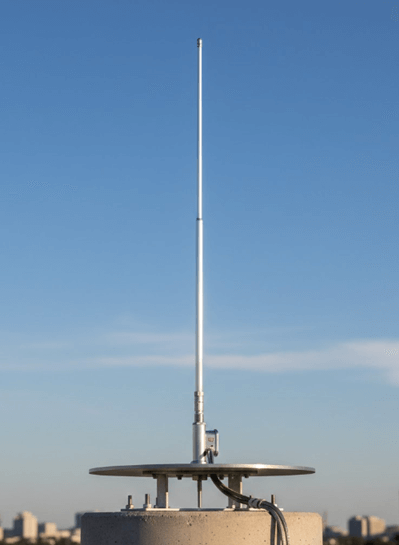
A monopole antenna is a single conductive radiating element mounted over a conductive ground plane. It is typically implemented as a vertical rod or trace and operates using the ground plane as a reference and return path for current. Monopole antennas are commonly designed as quarter-wavelength radiators.
Understanding Dipole Antenna
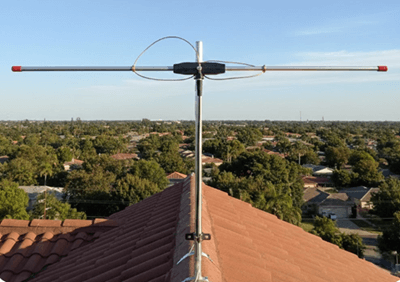
A dipole antenna consists of two equal conductive elements arranged symmetrically and fed at the center. The total length is typically about half the operating wavelength. Dipoles are balanced antennas and do not require an external ground plane to function.
Structure and Operation of Monopole and Dipole Antennas
Dipole Structure and Operation
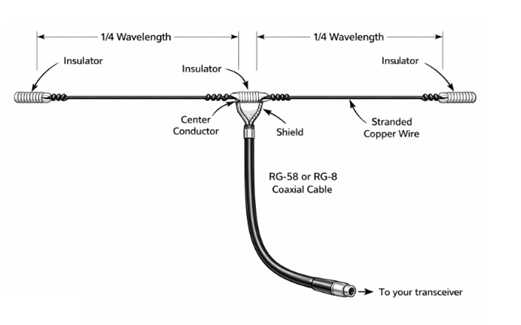
A dipole antenna consists of two conductors extending in opposite directions from a central feed point. When driven by an alternating current, standing waves of voltage and current form along the conductors. These time-varying currents generate electric and magnetic fields that propagate as electromagnetic radiation.
A half-wavelength dipole operates as a resonant structure with predictable current distribution. It produces a symmetrical radiation pattern with maximum radiation perpendicular to the antenna axis and nulls along the axis. Because it is balanced and self-contained, its behavior is stable when placed away from conductive objects.
Monopole Structure and Operation
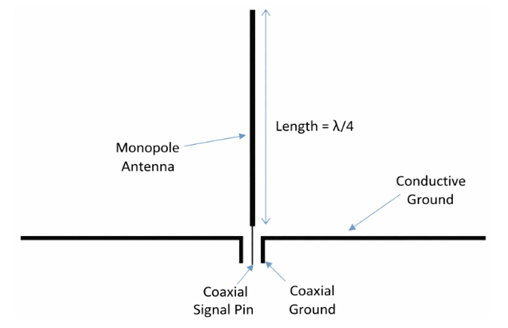
A monopole antenna typically consists of a single conductor positioned above a conductive ground plane. In most practical designs, it is a quarter-wavelength radiator. The ground plane reflects electromagnetic fields and creates a virtual image of the missing half of the antenna. As a result, a quarter-wavelength monopole behaves similarly to a half-wavelength dipole operating above a reflective surface.
Monopoles are fed asymmetrically, with the ground plane acting as the return current path. Radiation is omnidirectional in the horizontal plane but confined to the region above the ground plane, producing vertical asymmetry. The electrical performance of a monopole depends strongly on the size, conductivity, and orientation of the ground plane.
Comparison of Monopole and Dipole Antennas
| Feature | Monopole Antennas | Dipole Antennas |
|---|---|---|
| Structure | Single radiating element above a ground plane | Two symmetrical elements fed at the center |
| Radiation Pattern | Omnidirectional in the horizontal plane; confined above ground plane | Symmetrical pattern with maximum radiation perpendicular to antenna axis |
| Gain | Can reach ~5–6 dBi with a sufficiently large ground plane | Typically, ~2–3 dBi for a half-wave dipole |
| Bandwidth | Design-dependent; can be narrow or widened using sleeve structures or matching networks | Design-dependent; bandwidth can be increased using folded dipoles or matching techniques |
| Efficiency | Strongly dependent on ground-plane size and quality | Generally high and stable when isolated from nearby conductors |
| Ground Plane | Required; directly affects impedance and radiation | Not required |
| Feed Type | Unbalanced (e.g., coaxial cable) | Balanced feed or balun required |
| Installation Sensitivity | Sensitive to mounting location and grounding | Less sensitive to surrounding structures |
| Size | Compact and easy to integrate | Larger physical length |
| Design Flexibility | Easily integrated into PCBs, chassis, and vehicles | Can be bent, folded, or configured for specific polarization needs |
Applications of Monopole and Dipole Antennas
• Broadcasting (AM/FM): Large vertical monopole towers are commonly used in AM broadcasting because the Earth acts as an effective ground plane, enabling efficient long-range ground-wave propagation. FM broadcasting often uses dipole arrays mounted at height for controlled radiation patterns and polarization management.
• Mobile Communications: Quarter-wave monopoles are widely used in vehicles and handheld devices, where the chassis or PCB serves as the ground reference. Their compact size and ease of integration make them ideal for smartphones, IoT devices, and embedded systems.
• Satellite and Aerospace Systems: Dipole and crossed-dipole configurations are commonly used when predictable radiation patterns and polarization control are required. Dual-polarized or circularly polarized dipole structures help mitigate signal fading due to orientation changes.
• Wireless LAN and Access Points: External router antennas are often sleeve dipoles or printed dipoles designed for improved bandwidth and stable indoor coverage. PCB-integrated monopoles are common in compact consumer devices where space is limited.
Polarization Characteristics of Monopole and Dipole Antennas
Polarization describes the orientation of the electric field of the radiated wave. Both monopole and dipole antennas typically produce linear polarization based on their physical orientation.
Vertically mounted monopole antennas produce vertical polarization, which is well suited for terrestrial mobile communication systems. Dipole antennas offer greater flexibility, as they can be mounted vertically or horizontally to achieve the desired polarization. Crossed dipole configurations can provide dual polarization, improving performance in multipath environments.
Monopole and Dipole Antennas Electrical Performance
Input Impedance and Matching
Input impedance directly affects power transfer efficiency. A half-wavelength dipole in free space has an impedance of approximately 73 ohms, making it relatively easy to match to standard transmission lines. A quarter-wavelength monopole over an ideal ground plane has an impedance of approximately 36.5 ohms and often requires impedance matching.
Matching techniques such as LC networks, quarter-wave transformers, and tuning circuits are used to minimize reflections, increase bandwidth, and protect transmitters.
Radiation Efficiency
Dipole antennas typically maintain high radiation efficiency due to their balanced structure and independence from external conductors. When installed away from large conductive objects, their performance remains stable and predictable.
As discussed in Section 3.2, monopole efficiency is closely tied to ground-plane quality. In compact devices with limited grounding, losses and current imbalance can reduce efficiency. You can often accept this trade-off to achieve smaller size and easier integration.
Performance Measurement
In practical systems, antenna performance is evaluated using parameters such as Voltage Standing Wave Ratio (VSWR) and S11 (return loss). These measurements indicate how effectively power is transferred from the transmission line to the antenna.
A well-matched dipole typically exhibits a return loss better than −10 dB at resonance, corresponding to a VSWR below 2:1. Monopole antennas may show greater variation in S11 depending on ground-plane conditions. You can often use vector network analyzers (VNAs) to measure impedance matching and optimize antenna tuning within the final installation environment, since actual mounting conditions significantly influence results.
Conclusion
Monopole and dipole antennas each offer clear advantages depending on design constraints and application goals. Monopoles excel in compact, ground-referenced systems, while dipoles provide balanced operation and predictable performance. By examining their operation, ground-plane dependence, efficiency, and matching requirements, you can make informed antenna choices that optimize reliability, coverage, and overall wireless system performance.
Frequently Asked Questions [FAQ]
Which antenna is better for indoor use: monopole or dipole?
Dipole antennas are generally better for indoor use because they do not depend on a ground plane and provide more predictable performance when placed away from walls, metal objects, and electronic devices.
Can a monopole antenna work without a ground plane?
A monopole antenna can radiate without a proper ground plane, but performance will degrade significantly. Reduced efficiency, impedance mismatch, and distorted radiation patterns are common without an adequate ground reference.
Why do monopole antennas often show higher gain than dipole antennas?
Monopole antennas concentrate radiation into the upper half-space above the ground plane, effectively increasing gain compared to dipoles, which radiate symmetrically in all directions perpendicular to the antenna axis.
How does antenna height affect monopole and dipole performance?
Greater antenna height generally improves coverage by reducing ground losses and obstructions. This effect is especially important for monopole antennas, where height also influences ground-plane interaction and radiation efficiency.
Are monopole and dipole antennas suitable for modern IoT devices?
Yes. Monopole antennas are widely used in compact IoT devices due to their small size and PCB integration, while dipole antennas are preferred in external or gateway devices where efficiency and consistent performance are priorities.


