


Reliable protection is important for any medium-voltage power system, especially during faults such as short circuits or overloads. Vacuum circuit breakers (VCBs) help in ensuring safe and rapid current interruption while maintaining system stability. This article explains the construction, working principle, ratings, advantages, applications, and maintenance of VCBs to help clarify how they protect modern electrical networks.
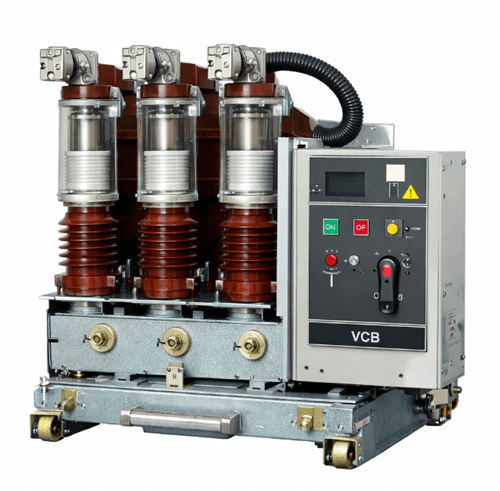
Vacuum Circuit Breaker (VCB) Overview
A vacuum circuit breaker (VCB) is a medium-voltage circuit breaker that uses a sealed vacuum interrupter as the arc-extinguishing and insulating medium to interrupt and isolate current during switching and fault conditions. It typically applies to systems up to about 36–38 kV, where fast, reliable interruption is required.
Construction of a Vacuum Circuit Breaker (VCB)
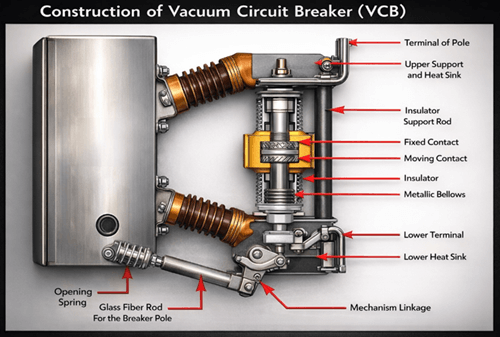
A vacuum circuit breaker is built from mechanical and electrical parts that work together to open and close the circuit safely. These parts are mounted on insulated supports inside the breaker housing to keep the structure inflexible and to withstand switching forces and electrical stress. Each pole contains a vacuum interrupter, which is where current interruption and arc extinction actually happen.
Working Principle of a Vacuum Circuit Breaker (VCB)
A vacuum circuit breaker works by interrupting an electrical arc inside a sealed vacuum interrupter. When a fault occurs, such as a short circuit or an overload the protection system detects the abnormal condition and sends a trip signal to open the breaker. As the contacts begin to separate, current still tries to flow across the narrowing gap, so an arc forms between the contacts.
Inside the vacuum interrupter, this arc can exist only because a small amount of metal vapor is released from the contact surfaces. Unlike air or other media, the vacuum has almost no particles available to support continuous ionization. As the alternating current reaches its natural zero point, the metal vapor quickly condenses, causing the arc to extinguish almost instantly.
After the arc disappears, the vacuum gap regains its dielectric strength very rapidly. This fast recovery prevents the arc from striking again in the next half-cycle, allowing the breaker to stop the current completely and isolate the faulty part of the system, helping protect the rest of the electrical network.
Types of Vacuum Circuit Breakers
By Installation Environment
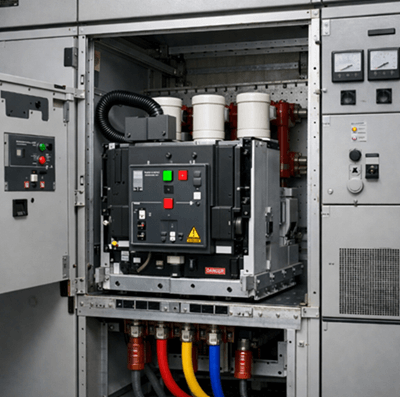
• Indoor VCB – Installed inside switchgear panels and indoor substations; not designed for direct weather exposure.
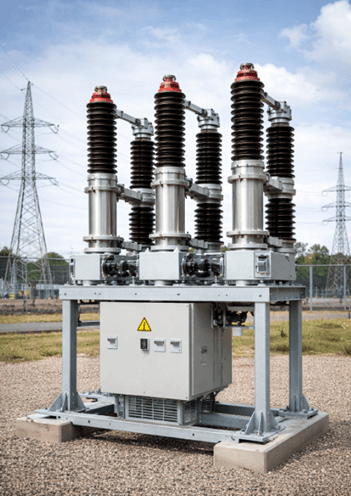
• Outdoor VCB – Built with weather-resistant enclosures for outdoor substations and exposed locations.
By Mounting / Service Method
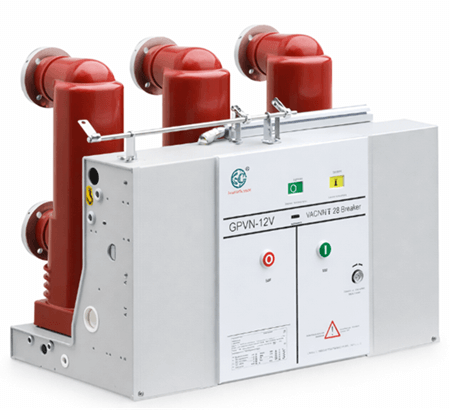
• Fixed-Mounted VCB – Permanently installed in the switchgear; maintenance usually requires shutdown and isolation.
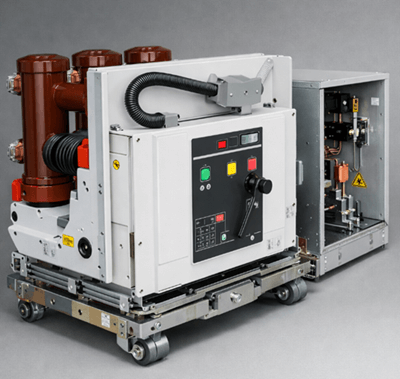
• Draw-Out (withdrawable) VCB – Mounted on a cradle/truck and can be withdrawn for inspection, testing, or replacement.
By Pole / Insulation Construction
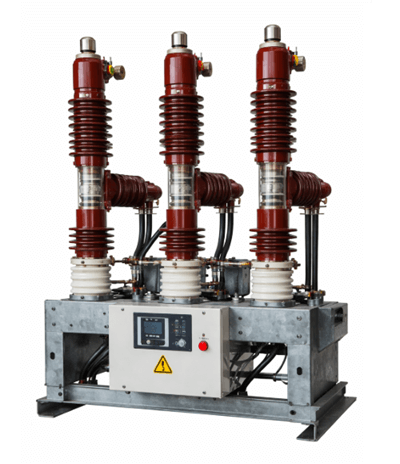
• Conventional Pole (air-insulated pole) VCB – Interrupter is mounted in open air inside the switchgear with external insulation clearances.
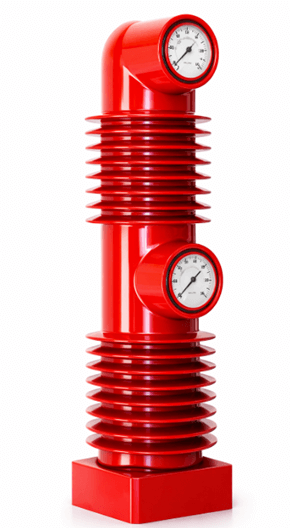
• Embedded Pole VCB – Vacuum interrupter is embedded in solid insulation (often epoxy), improving mechanical strength and reducing contamination risk.
By Operating Mechanism
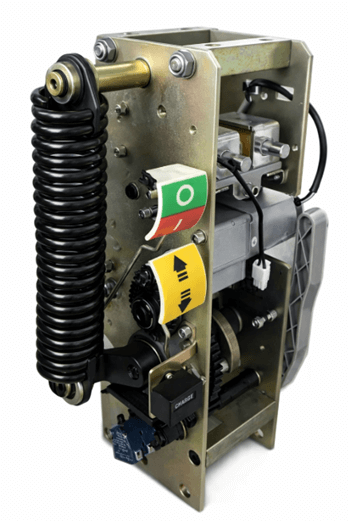
• Spring-Operated (stored-energy) VCB – Spring charged manually or by motor; most common in MV switchgear.
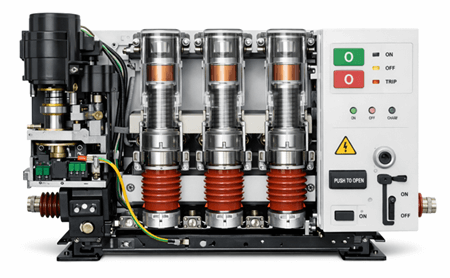
• Magnetic Actuator VCB – Uses an electromagnetic actuator; fewer moving parts and supports high operating endurance (design-dependent).
Ratings and Technical Specs of VCBs
| Specification | Typical Values / Notes |
|---|---|
| Rated Voltage | 11 kV, 22 kV, 33 kV, 36 kV |
| Rated Current | 630 A, 1250 A, 2000 A, 3150 A |
| Rated Short-Circuit Breaking Current | 16 kA, 25 kA, 31.5 kA, 40 kA |
| Rated Making Current | Typically, higher than the breaking current rating |
| Rated Insulation Level | Defined by impulse withstand voltage ratings |
| Mechanical Endurance | Typically, 10,000 – 30,000 operations |
| Electrical Endurance | Depends on design and interrupting duty |
Contact Materials Used in Vacuum Interrupters
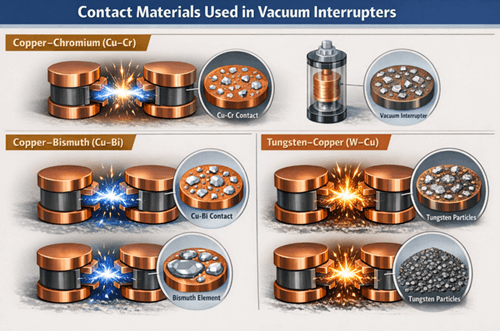
The contact material used in a vacuum interrupter is important because it directly affects arc behavior, electrical conductivity, and overall contact life. An ideal material should carry current with low resistance, withstand arc erosion during interruption, resist contact welding when the contacts separate and close, conduct heat away efficiently, and remain stable after many switching operations.
Copper–Chromium (Cu–Cr)
Copper–chromium (Cu–Cr) is the most widely used contact material in modern vacuum interrupters. It combines strong electrical conductivity with excellent resistance to arc erosion and a low tendency for contact welding, which helps extend service life. The chromium content improves arc stability and reduces material loss during interruption, making Cu–Cr a dependable choice for typical medium-voltage switching duties.
Copper–Bismuth (Cu–Bi)
Copper–bismuth (Cu–Bi) contacts are used in some medium-voltage interrupters where good arc control and reduced welding risk are needed. Bismuth helps lower the likelihood of contacts sticking after repeated operations, supporting reliable interruption performance in suitable applications.
Tungsten–Copper (W–Cu)
Tungsten–copper (W–Cu) alloys are selected for demanding duties because tungsten provides high-temperature strength and strong resistance to arc erosion, while copper supports electrical and thermal conductivity. This combination makes W–Cu suitable for applications that require very high durability under severe arcing, although it is generally used more selectively compared to Cu–Cr.
Applications of Vacuum Circuit Breakers
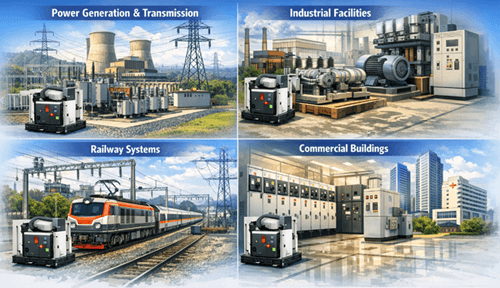
Power Generation and Transmission
VCBs protect key equipment such as generators, transformers, busbars, and outgoing feeders in power plants and substations. They help isolate faults quickly to reduce damage and maintain system stability.
Industrial Facilities
Industrial plants use VCBs to protect large motors, transformers, capacitor banks, and distribution panels. They are well-suited for frequent switching duties and help reduce downtime caused by electrical faults.
Railway Systems
Railway networks use VCBs in traction substations and switching stations to protect traction power supplies, feeders, and some control or signaling-related power circuits. Their fast operation supports reliable service and safer fault isolation.
Commercial Buildings
High-rise buildings, hospitals, malls, and commercial complexes use VCBs in main switchboards and medium-voltage distribution rooms. They protect distribution feeders and critical loads while supporting safe switching for maintenance and system changes.
Vacuum Circuit Breaker Compared with Other Switching Devices
Vacuum Contactor vs Vacuum Circuit Breaker
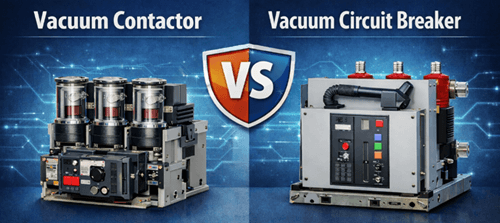
| Feature | Vacuum Circuit Breaker (VCB) | Vacuum Contactor |
|---|---|---|
| Main purpose | Protects the system by interrupting normal and fault currents | Switches load currents frequently; fault interruption is usually handled by fuses |
| Fault interruption | Designed to interrupt short-circuit current safely | Not intended to interrupt high fault currents (typically used with fuses) |
| Switching duty | Suitable for switching and protection duties | Best for very frequent switching (especially motors) |
| Electrical endurance | High for fault interruption duty | Very high for repetitive load switching duty |
| Control behavior | Can remain latched closed even if control voltage is lost (design-dependent) | Often drops open if control voltage is lost (design-dependent) |
| Maintenance | Moderate (mechanism, connections, inspections) | Low (mainly inspections and connections) |
| Cost | Higher | Moderate |
| Common uses | MV feeders, transformers, generators, substations | Motor switching, capacitor switching, frequent operations |
VCB vs Other Circuit Breaker Types
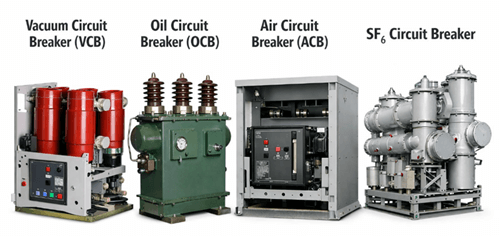
| Circuit Breaker Type | Arc-Quenching Medium | Typical Voltage Range | Maintenance Requirement | Environmental / Safety Notes |
|---|---|---|---|---|
| Vacuum Circuit Breaker (VCB) | Vacuum | Medium voltage (typically up to ~36–38 kV) | Very low | No oil handling; no SF₆ gas |
| Oil Circuit Breaker (OCB) | Insulating oil | Medium voltage (older systems) | High | Fire risk; oil aging and handling required |
| Air Circuit Breaker (ACB) | Air | Low voltage (typically below 1 kV) | Moderate | No oil/gas; mainly used in LV switchboards |
| SF₆ Circuit Breaker | SF₆ gas | MV and HV | Low to moderate | Excellent insulation, but SF₆ has high global warming potential |
Maintenance of Vacuum Circuit Breakers
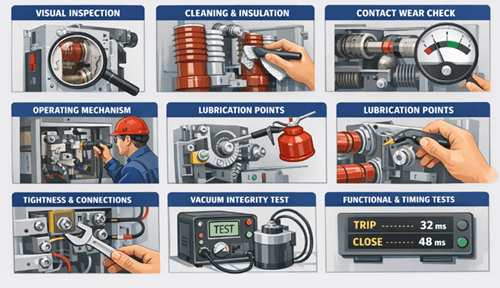
• Visual inspection: Check the breaker housing, insulators, bushings, and terminals for cracks, tracking marks, dirt buildup, corrosion, loose hardware, or heat discoloration. Look for signs of overheating at cable lugs and connections.
• Cleaning and insulation condition: Remove dust and contamination from insulation surfaces and around terminals. Verify insulation parts are dry and free from carbon marks or surface damage that could reduce dielectric strength.
• Contact wear inspection: VCB contacts wear slowly, but they still wear with frequent switching and fault interruptions. Use the built-in wear indicator (if provided) or follow the measurement method to confirm the contact erosion is within limits.
• Operating mechanism check: Inspect linkages, springs, latches, and moving parts for smooth travel and proper alignment. Confirm the breaker opens and closes correctly and that the charging/closing system operates normally.
• Lubrication: Lubricate only the specified mechanism points and use the correct lubricant type and amount. Avoid over-lubrication, since excess grease can attract dust and cause sticking over time.
• Tightness and connection checks: Re-torque power terminals and grounding points as required. Check control wiring, auxiliary contacts, and plug connections for looseness, wear, or damage.
• Vacuum integrity test: The vacuum interrupter must keep a strong vacuum seal to interrupt safely. Use the recommended vacuum test method (commonly high-potential/withstand testing or dedicated vacuum-check equipment) to confirm the interrupter is still healthy.
• Functional and timing checks: Where required, verify operating timing, trip/close functions, and interlocks to ensure the breaker responds consistently and within acceptable limits.
Testing and Inspection of Vacuum Circuit Breakers
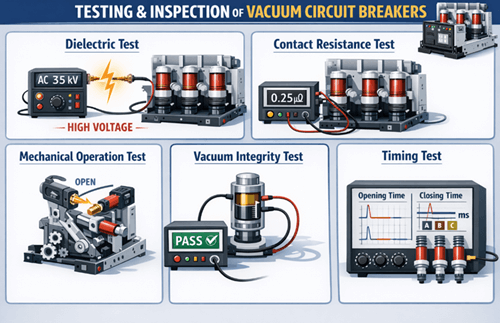
Before installation and during scheduled maintenance, vacuum circuit breakers (VCBs) should be tested and inspected to confirm they can interrupt faults safely and operate smoothly. These checks also help detect insulation weakness, contact problems, or mechanism wear before they cause a failure.
• Dielectric Test: This test checks the insulation strength of the breaker by applying a specified high voltage between terminals and ground (and sometimes across the open contacts). It helps confirm there is no breakdown of insulation, tracking, or internal flashover.
• Contact Resistance Test: A low-resistance (micro-ohm) measurement is used to verify the condition of the main contacts and the current path through terminals and connections. Rising resistance can point to contact wear, loose joints, contamination, or overheating risk.
• Mechanical Operation Test: The breaker is opened and closed several times to confirm correct operation of the closing/opening mechanism, linkages, latches, and springs. During this test, any abnormal noise, sticking, sluggish motion, or incomplete travel can be identified.
• Vacuum Integrity Test: This test confirms that the vacuum inside the interrupter is still maintained. Loss of vacuum reduces dielectric strength and can lead to poor interruption or internal failure, so checking interrupter integrity is a key VCB-specific inspection.
• Timing Test: Breaker opening and closing times are measured to ensure the mechanism operates within specified limits. It can also check pole synchronism (how closely the phases operate together), since uneven timing may increase switching stress and reduce reliability.
Future Developments in Vacuum Circuit Breaker Technology
• Embedded Pole Technology: In many modern switchgear designs, the vacuum interrupter and primary conductive parts are embedded in solid insulation (often epoxy resin). This “sealed” pole design improves mechanical strength, helps protect against moisture and contamination, and reduces the need for frequent cleaning or insulation maintenance. It can also improve consistency of insulation performance over time.
• Solid-Insulated Switchgear: New switchgear platforms increasingly use solid insulation systems instead of SF₆ gas. This reduces environmental impact and avoids gas-handling requirements. You can also often more compact and can be easier to install in indoor substations or space-limited sites, while maintaining strong dielectric performance.
• Digital Monitoring Systems: Modern VCBs may include sensors and monitoring tools that track operating condition and performance immediately, such as, operating cycles and duty history, contact wear or wear indicators, temperature at key joints or terminals, trip/close coil health and control voltage, and switching performance, including opening/closing time and pole synchronism. These features support predictive maintenance, where service is planned based on actual condition rather than fixed intervals. This can reduce unexpected failures and improve overall system reliability.
• Environmentally Friendly Designs: Manufacturers are placing more focus on eco-friendly materials and insulation systems, including designs that reduce greenhouse gas emissions and improve recyclability. The push for cleaner switchgear also encourages simpler, safer handling during installation and end-of-life disposal.
Conclusion
Vacuum circuit breakers are widely used in medium-voltage systems because they provide reliable fault interruption with fast dielectric recovery and low maintenance needs. Their sealed vacuum interrupter design limits arc exposure to external insulation, helping improve safety and long-term performance. Understanding VCB construction, operating principle, ratings, and service practices, it becomes easier to select, operate, and maintain switching equipment that supports stable and dependable electrical distribution.
Frequently Asked Questions [FAQ]
What voltage levels are vacuum circuit breakers typically used for?
Vacuum circuit breakers are mainly used in medium-voltage power systems, typically ranging from 1 kV to about 36–38 kV. They are commonly installed in distribution networks, industrial power systems, and substations where fast and reliable fault interruption is required.
How long does a vacuum circuit breaker typically last?
A vacuum circuit breaker usually has a service life of 20–30 years, depending on operating conditions and maintenance. Most VCBs can perform 10,000–30,000 mechanical operations and many fault interruptions before contact wear reaches its limit.
Why are vacuum circuit breakers considered safer than oil circuit breakers?
VCBs are safer because they do not use flammable oil or pressurized gas. The arc is contained inside a sealed vacuum interrupter, which reduces the risk of fire, explosion, and environmental contamination compared with oil-based breakers.
Can a vacuum circuit breaker interrupt both AC and DC currents?
Vacuum circuit breakers are primarily designed for AC power systems because arc extinction occurs naturally at the current zero point of alternating current. Interrupting DC current is much more difficult since DC has no natural current zero.
What factors should be considered when selecting a vacuum circuit breaker?
Key selection factors include rated voltage, rated current, short-circuit breaking capacity, insulation level, mechanical endurance, and installation type (indoor or outdoor). You can also consider system protection requirements and switching frequency to ensure reliable operation.


