


The main breaker controls the whole panel, while branch breakers protect separate circuits. This affects power loss, trip meaning, and safe checking steps. This article gives information about their function, location, trips, troubleshooting, and safety.
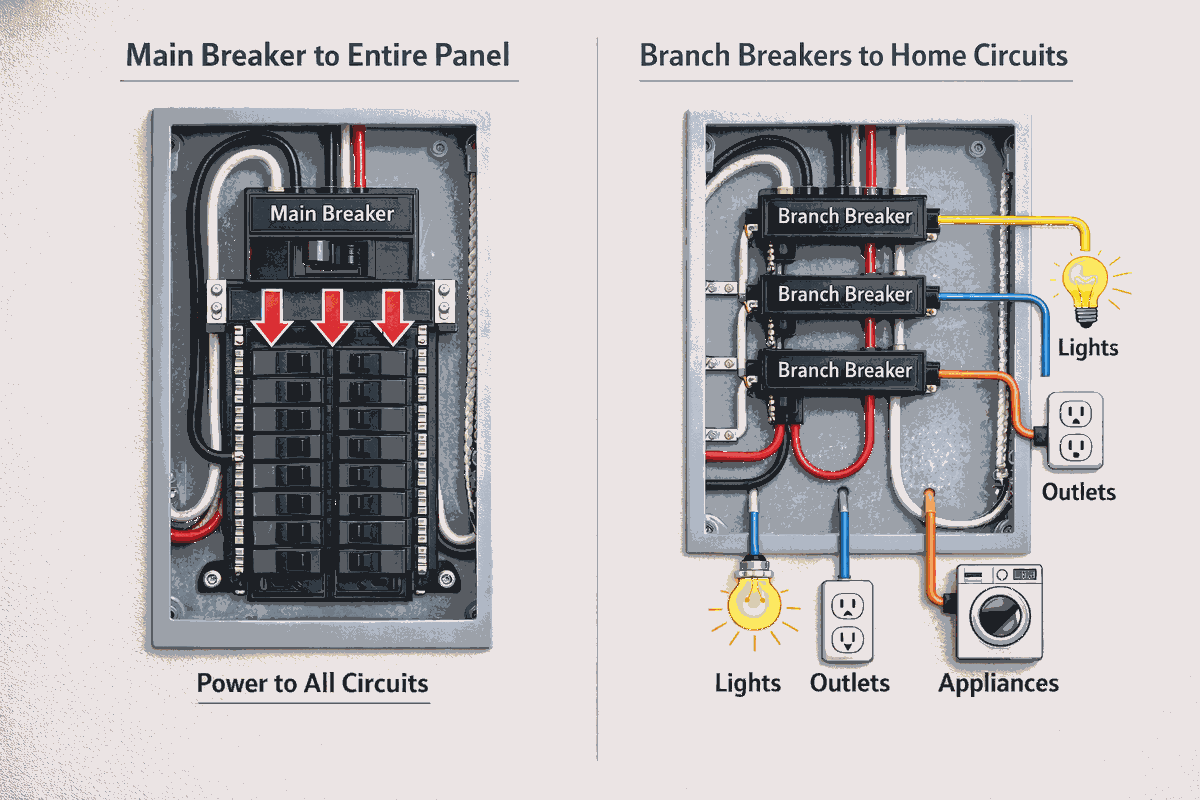
Main Breaker and Branch Breaker Basics
The main breaker is the main shutoff for the electrical panel. It controls the power entering the panel and can turn off power to all connected circuits simultaneously. A branch breaker works differently. It protects only one individual circuit in the panel.
Because of this, the result of a trip is not the same. When the main breaker trips, power is lost across the entire panel. When a branch breaker trips, only the circuit it serves loses power. This is the difference because it affects how much of the system is shut off.
Put simply, the main breaker protects and controls the full panel, while branch breakers protect separate circuits within that panel.
Breaker Protection and Control
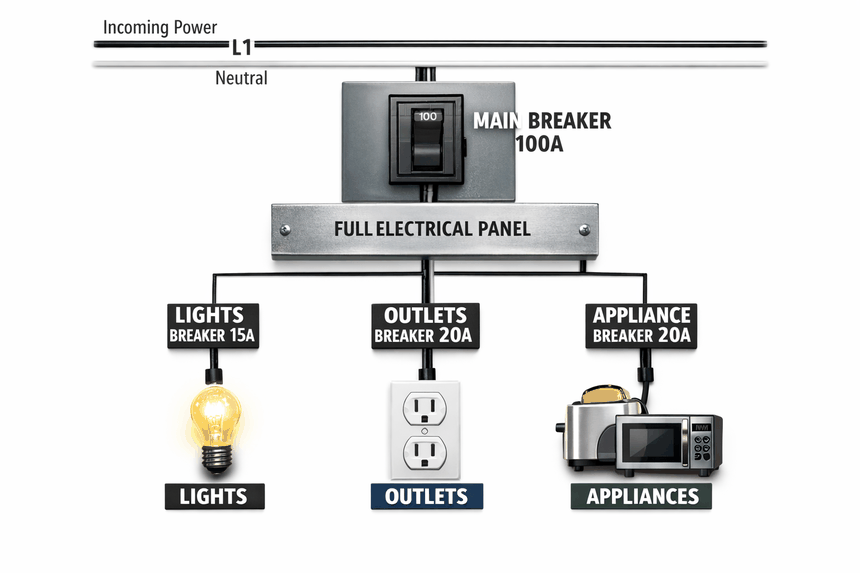
The main breaker protects and controls the entire electrical panel. It serves as the primary shutoff for the panel and disconnects power to all circuits at once when needed.
Branch breakers protect individual circuits within the panel. Each one controls a single circuit and cuts power only to that circuit if an overload or fault occurs.
This arrangement creates two levels of protection. The main breaker covers the full panel, while each branch breaker protects its own circuit. When a problem occurs on one circuit, the branch breaker trips first, helping keep the rest of the panel operating.
Meaning of a Breaker Trip
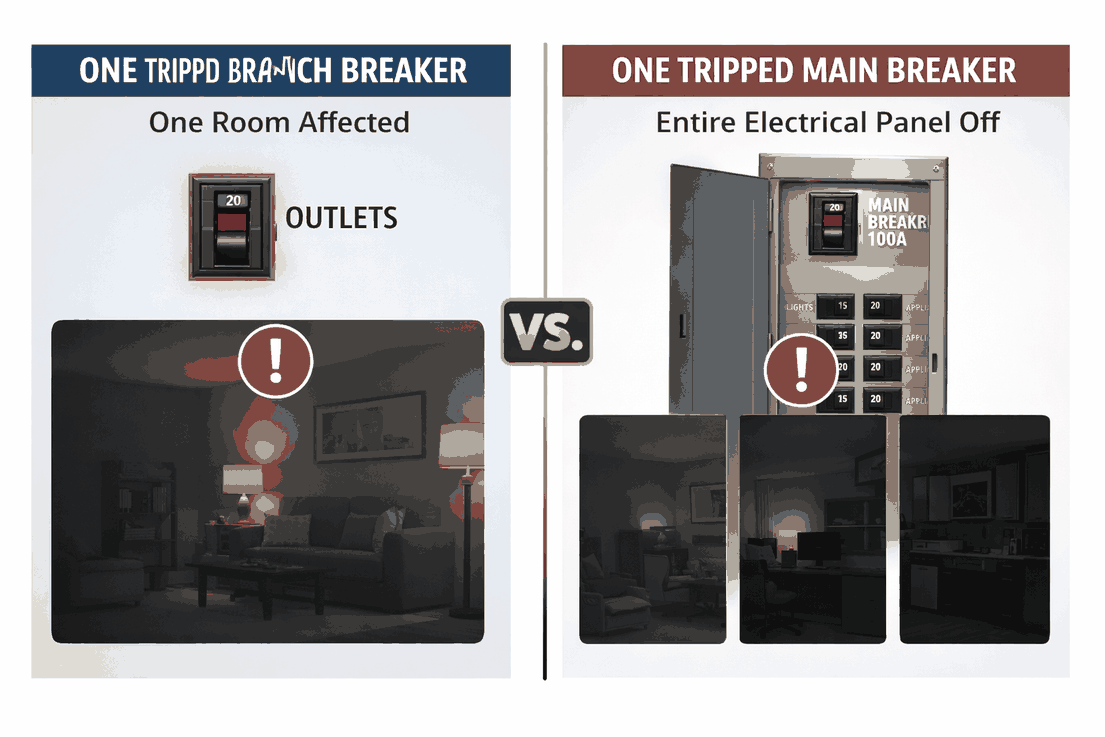
A breaker trips when it shuts off power after detecting an unsafe condition, such as excess current or an electrical fault. The meaning depends on whether the main breaker or a branch breaker has tripped.
A branch breaker trip indicates a problem in a single circuit. This may involve an overload, a short circuit, or a fault in that circuit. In most cases, the power loss is limited to one part of the home.
A main breaker trip points to a larger issue. It may be caused by excessive total load or a more serious fault affecting the panel or incoming power. Because this type of trip is less common, it should be taken seriously.
Safe Breaker Use
• Turn off connected loads before resetting a tripped breaker.
• Check the situation before restoring power.
• Do not keep resetting a breaker that trips again.
• Use the main breaker when the whole panel needs to be shut off.
• Contact a qualified electrician if the problem is serious or keeps happening.
Main Breaker vs. Branch Breaker Comparison
| Feature | Main Breaker | Branch Breaker |
|---|---|---|
| Primary role | Controls and protects the whole panel | Protects one individual circuit |
| Scope | Entire electrical panel | One specific circuit |
| Typical use | Whole-panel shutoff and panel-level protection | Circuit control and local fault protection |
| Trip effect | The whole panel loses power | Only one circuit loses power |
| Frequency of interaction | Less frequent | More frequent |
| Common trip cause | Total overload or a broader fault | Circuit overload, short circuit, or local fault |
Breaker Troubleshooting Steps
• Check how much of the home has lost power. See whether the outage affects a single outlet, a single room, several rooms, or the entire panel.
• If only part of the home is affected, check the branch breakers first.
• Look for a breaker that is out of position or sitting between on and off.
• Turn off or unplug items connected to that circuit.
• Reset the breaker once, using the proper reset position.
• If the breaker trips again, stop and check the circuit or connected equipment.
• If the outage affects the whole panel, check the main breaker.
• Watch for warning signs such as heat, burning smell, buzzing, or visible damage.
• Contact a qualified electrician if the problem repeats or appears serious.
Conclusion
The main breaker and branch breakers have different jobs, but both are basic for panel protection. The main breaker shuts off and protects the whole panel, while branch breakers protect individual circuits. The type of power loss helps show where the problem is. A proper response means checking the affected area, resetting carefully, avoiding repeated resets, and watching for signs that require a qualified electrician.
Frequently Asked Questions [FAQ]
Do breakers wear out?
Yes. Breakers can wear out over time and stop working properly.
Why does a breaker not reset?
It may still have a fault, or it may not have been switched fully to OFF first.
Can a bigger breaker replace a smaller one?
No. It can let too much current pass and overheat the wiring.
What makes GFCI and AFCI breakers different?
GFCI breakers protect against ground faults. AFCI breakers detect dangerous arcing.
Can one branch breaker shut off several outlets or lights?
Yes. One branch breaker can control multiple points on the same circuit.
Should a breaker be checked after it resets?
Yes. Resetting does not always mean the problem is fixed.


